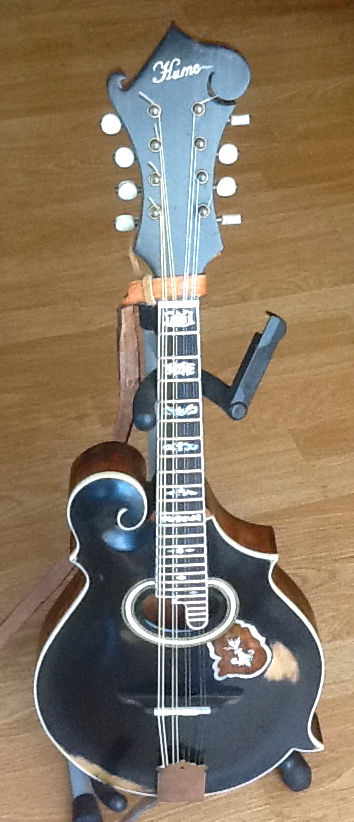
 In the late 1890’s, Orville Gibson began building stringed instruments using designs borrowed from violin-makers. Up until then all mandolins and guitars were essentially flat-topped. Mandolins, especially, were still being built much like lutes and Ouds from the Middle East in the 1400’s, with round backs/sides made from staves glued together like a barrel. They didn’t sound as good as he thought they could.
A group of businessmen purchased his designs and hired him as a consultant in the manufacture of guitars, mandolins, and other instruments in a factory in Kalamazoo, MI. After a year or two, the parties separated, due to creative differences, but the company continued on under the Gibson name.
The instruments made from 1900 to 1910, especially, bear the design flourishes of Orville Gibson. Later, changes were made to the designs to enhance mass-production – in particular by a musician/engineer named Lloyd Loar. Mandolins signed by Loar frequently are sold today in the $250,000 range. They are the “holy-grail” of mandolins. Roger Siminoff has a very good website on Loar, which you can find here.
But I digress… Many dozens of manufacturers, and probably hundreds of small makers build copies of Loar’s mandolins due to their popularity among Bluegrass players. But you hardly EVER see any of the pre-1920’s Gibsons. They are way too few and don’t get taken out much due to their value (not worth as much as a Loar, but still in the thousands-of-dollars range).
I wanted a mandolin that would make people’s heads turn – cause folks to say: “What the heck is THAT? Is that what I think it is?”
The basic idea here was to build an oval-hole, three-point mando that looks like a 1910 F-3. I made one of these back in 2006 which got sold right away, but the problem is that the body size of those pre-1920‘s is bigger by about 15% than a Loar-era F-4. The sound is boomier, and you can’t find a pre-made case that will fit, either.
Sooooo – I decided to call this model the “F-3 Mini” since it is built on a Loar F-4 body size instead of the larger official F-3 plan. What makes these older oval-hole mandos special is the inlaid pickguard, as well as the intricate fretboard Mother of Pearl inlays. The scroll is carved more like Orville’s original design, rather than the crested-point scroll of the Loar era. The back and sides are American Birch, which was very common, and is a little easier to carve than rock Maple. And rather than transverse bracing, (for you mandolin nerds) I X-braced it, and it sounds sweet. It won’t win in a head-to-head blow-out with a 5-string banjo, but if that’s what you’re after, I know a guy who sells accordions. Here’s a picture from my phone with my buddy Ross Landry test-picking it:
 Woodsong Strings