
A couple of months ago I stumbled across the story of The Elias Howe Company that sold great mandolin family instruments, as well as guitars, in the 1890’s through 1931 in Boston. I say “sold” instead of “built” since it is generally accepted that the instruments were manufactured by one of the large local factories in the Boston metro area.
After reading this article by Gregg Miner (http://www.minermusic.com/eliashowe.htm) I went looking for other pictures, and discovered that although examples of these instruments are exceedingly rare, there was a mandolin on display not to far from where I live at the Museum of Making Music in Carlsbad, California. Intrigued, I talked my wife into a weekend drive down to check it out.
What makes these instruments interesting to me is that they are the first documented example of archtops on non-viol stringed instruments. Patented in 1893 and 1895, these little guitar-shaped dudes pre-date the carved archtops of Orville Gibson by several months.
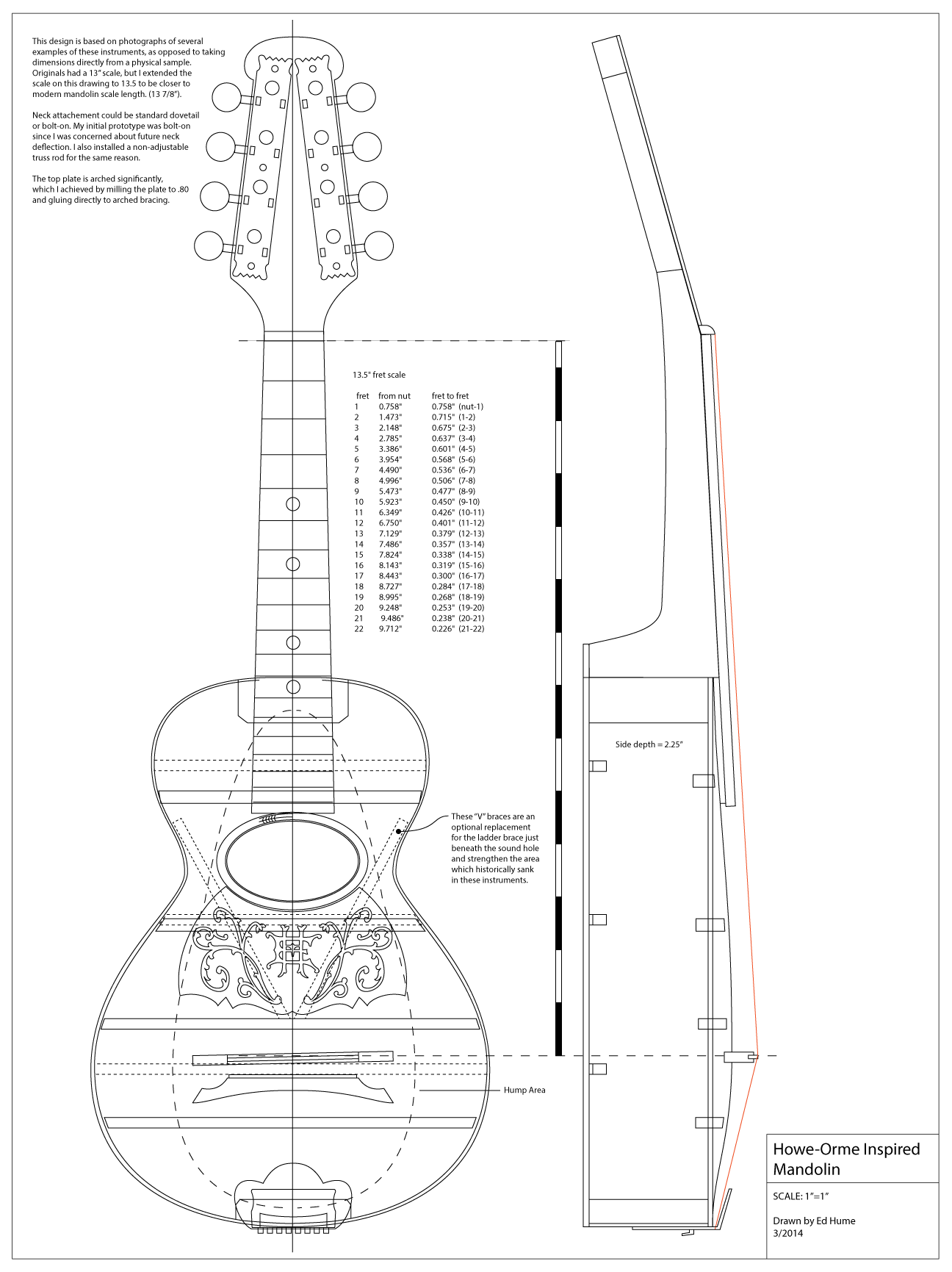
So with a bit of work, what you see here is a reproduction (as near as I could make it without an example to inspect) of a Howe-Orme mando. The sides and back are dyed Bubinga, top is Sitka Spruce. Neck is mahogany, and headstock veneer and fretboard are ebony. Barely 22″ long and 8″ wide, this little guy will make a great travel instrument. Plus, I expect it to be a “jam-buster” at any uke jam – as it’s much louder that any similar sized ukelele.
 Woodsong Strings
hello. I wander how to get this curve what nigel forster call cylinder. I have got the intention of building a bouzouki with the howe orme top tape like the one you can see in
could you please tell me how to get this curve? thank you
Hi Oscar. The Howe-Orme “hump” on the old guitars was an arch across the lower bout formed by the ladder bracing the builders used. Unlike today’s guitars, the tail end of the sides rise up to match the hump. Another way to describe it is that the hump is like the top was formed around a cylinder, as opposed to a sphere as modern guitars are designed. On my little mando copy, I forced the tail end of the top down to meet the sides with clamps, but didn’t profile the sides since my examination of an original showed Howe-Orme did it that way on the smaller instruments they made. Hope this helps.
Actually if you go to the 42 second mark in the video and pause it you can see what I described. Good luck in your build!